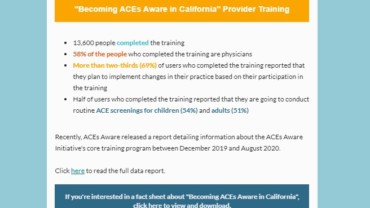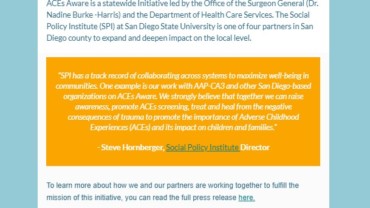
Introducing, the ACEs Aware Initiative! We are excited to be involved in this new initiative, led by the Office of the Surgeon General, with our partners at the YMCA and the Academy of Pediatrics Chapter 3 (AAP-CA3) to expand and deepen the impact on the local level. In this newsletter, we share what this initiative entails including a Network of…
See the latest from the Social Policy Institute including how COVID-19 has affected the elderly in San Diego, information on a new collaborative project led by United Parents, and how to get involved in the Networks of Care as part of the ACEs Aware Initiative. Read the full newsletter here: October 2020
In alignment with the Office of Child Abuse Prevention’s vision, and in partnership with Strategies 2.0 and CAPCs throughout the state, the Social Policy Institute has developed Best Practice Guidelines for California CAPCs. Child Abuse Prevention Councils (CAPCs) are the catalyst, convener and coordinator of the countywide approach to prevention of child maltreatment. Each CAPC prioritizes strategies for action that…
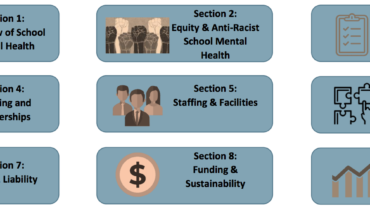
“We know that schools, families, and communities are eager to support the mental health of children and adolescents, especially in this time of intense crisis. This practical guide provides a variety of resources to start and expand these critical services at a time when they are most needed.” -Tracy Mendez, Executive Director of the California School-Based Health Alliance. In partnership…
The Breaking Barriers Toolkit was developed to highlight the essential components of effective cross-systems practice and the strategies that improve outcomes for children, families and communities. Implementation of these practice components—Shared Leadership, Shared Data and Outcomes Management, Shared Fiscal Management, and Shared Community—leads to successful integration of care and services, thereby addressing the unmet social, emotional and developmental needs of…
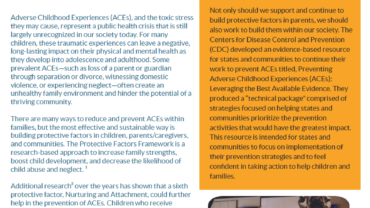
The 5 Protective Factors are widely known in the Family Strengthening Field as a way to increase family strengths and decrease the likelihood of child abuse and neglect. They can also play a significant role in preventing and reducing Adverse Childhood Experiences (ACEs) in children and families. In our newest knowledge to action brief, we discuss a 6th protective factor,…
The majority of people living in California have experienced at least one (1) adverse childhood experience (ACE). Fully 16% have experienced 4 or more ACEs. In SPI’s first ACEs Aware Knowledge to Action Brief, we focus on the challenges children face in the midst of adverse childhood experiences (ACEs) and how lasting impacts can be prevented or reduced using the…
While the Centers for Disease Control and Prevention (CDC) currently reports that the risk of exposure to COVID-19 is low for young Americans, research on natural disasters makes it clear that, compared to adults, children are more vulnerable to the emotional impact of traumatic events that disrupt their daily lives. This resource offers information on supporting and protecting children’s emotional…